
CHADD on the Global Stage: Highlights from the 10th World ADHD Congress
In early May 2025, over 2,400 researchers, clinicians, educators, and advocates from 79 countries gathered in Prague for the 10th World Congress on ADHD. The event marked a major milestone for the global ADHD community, and for the first time, CHADD was represented not only as a participant, but as a member organization of the World Federation of ADHD.
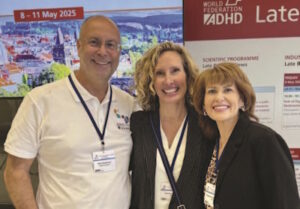
Phil Anderton, PhD, from UK-based ADHD360, with Jeremy Didier and Suzanne Sophos.
CHADD President Jeremy Didier and President-Elect Suzanne Sophos donated their time and travel arrangements to represent the organization at the event. Among the esteemed presenters were several members of CHADD’s committees, including David Goodman, MD, Margaret Sibley, PhD, and Craig Surman, MD.
“It was both energizing and deeply meaningful to be there in person—engaging with global ADHD leaders, learning from their expertise, and representing CHADD on the international stage,” said Sophos. “Jeremy and I were honored to take part in conversations and sessions that will help shape the global effort to improve outcomes for individuals with ADHD.”
The Congress itself offered an impressive array of sessions across clinical and scientific tracks. On the final day, a lived experience afternoon was also offered for local attendees in the Czech language. One of the most striking themes was the call to reframe ADHD not only as a disorder, but as a form of lifelong neurodiversity that impacts the lived experience of individuals in an all-encompassing way.
“Being in the room with the leading minds behind this life-changing ADHD research—and among the first to hear their findings—was a powerful experience,” according to Didier. “We left feeling profoundly grateful to serve on CHADD’s board and to help bring that knowledge back to our members and community.”
Centering lived experience
Speakers across sessions emphasized the need for clinicians and researchers to engage more deeply with the perspectives of people with ADHD when developing diagnostic criteria, treatment protocols, and public health recommendations. It was noted that existing recommendations and ADHD treatment options can often fail to reflect and address the full day-to-day realities of individuals navigating ADHD across different life stages.
A glimpse into the US Adult Treatment Guidelines

Outside the World Congress venue (l–r): Jeremy Didier; Suzanne Sophos; Karen Saporito, PhD; and Tamara Rosier, PhD.
One notable example of this shift was the upcoming United States Adult Diagnosis and Treatment Guidelines, being developed by the American Professional Society of ADHD and Related Disorders (APSARD). Set to be released in late 2025, the guidelines are being shaped with direct input from individuals living with ADHD, as well as insights from the international community.
CHADD is partnering with APSARD to develop a series of educational toolkits that will help current healthcare providers as well as physicians and nurse practitioners in training learn how to implement these new guidelines in real-world settings. These resources are intended to make the guidance more accessible to clinicians across disciplines and to support a more unified, evidence-informed approach to adult ADHD care. At the Congress, APSARD representatives shared how the forthcoming guidelines aim to move beyond a deficit-based model and toward a strengths-informed, person-centered approach.
The guidelines are expected to address not only pharmacological treatments, but also integrated care models, coexisting conditions, and life transitions such as late diagnosis and aging. Informed by real-world complexity, the project represents a landmark moment for adult ADHD care in the United States—and signals a broader global trend toward honoring lived experience as clinical evidence.
ADHD coaching highlights
Tamara Rosier, PhD, and Margaret Sibley, PhD, co-presented findings from the US National Survey on ADHD Coaching during a session titled “ADHD Coaching on the Rise: Understanding Coaches and Their Role in Support.” Chaired by Dr. Sibley and Emily Simonoff, MD, the session explored the evolving landscape of ADHD coaching.
Dr. Rosier opened the session by setting the stage with an overview of ADHD coaching—its role in treatment, themes emerging across the field, and how coaching fits into the broader support ecosystem. She highlighted key insights from existing research and outlined future directions for practice and policy.
Dr. Sibley followed with results from the national survey, offering a detailed snapshot of the ADHD coaching workforce and client demographics. Key findings included: 80% of coaches are women; 97% practice virtually, while only 44% offer in-person sessions; and 66% hold a master’s degree or higher. Notably, over 58% reported having no formal coaching certification. Most coaches came from education (32%), followed by business (10.9%) and mental health (10.7%).
Together, their presentations underscored the growing role of coaching as an essential part of a multimodal approach to treating ADHD.
Medication safety and monitoring
Tobias Banaschewski, MD, PhD, and others presented updated research on the cardiovascular effects of ADHD medications, reaffirming that both stimulants and nonstimulants can lead to small increases in blood pressure and heart rate. While these effects are typically within safe limits, speakers emphasized the importance of monitoring, especially with long-term, high-dose use. This topic sparked thoughtful conversations about balancing benefits with potential risks, and about tailoring medication strategies to individual health profiles.
Innovative interventions
From exergaming for children to emotion regulation therapies for adults, the Congress spotlighted emerging interventions designed to address core symptoms and co-occurring challenges. Presenters like Samuele Cortese, MD, PhD, shared data on psychoeducational programs tailored to youth, which showed promising results, particularly when paired with caregiver engagement. One particularly engaging session demonstrated how digital tools and gamified platforms can support attention, memory, and executive function skills in school-aged children.
Hormones and ADHD: A growing area of focus
The intersection of ADHD and female hormonal health was a prominent topic. Research presented by Sandra Kooij, MD, PhD, along with contributions from Margaret Weiss, MD, PhD; Ellen Littman, PhD; and Dora Wynchank, MD, PhD, explored how menstrual cycles, pregnancy, and menopause impact ADHD symptoms and treatment efficacy. Many women report a worsening of executive dysfunction or emotional regulation challenges during hormonal shifts. Perimenopause in particular emerged as a time of vulnerability, often misdiagnosed as depression or anxiety rather than recognized as ADHD-related. The call for more research, clinician training, and personalized care protocols was clear. There was also recognition that gender-diverse individuals may experience similar challenges and deserve targeted research and support.
Global workplace supports
Sessions highlighted workplace inclusion strategies from around the world. For example, Philip Asherson, PhD, and his colleagues presented data on the United Kingdom’s Access to Work program, while Australian researchers discussed national funding efforts to support neurodivergent workers. As more adults receive ADHD diagnoses later in life, workplace accommodations and flexible environments are becoming vital to long-term well-being. Speakers emphasized the importance of moving beyond compliance to creating environments that genuinely support attention, focus, and emotional regulation.
Early career research recognition
The Congress also celebrated early career scientists pushing the field forward. Amalie Austgulen, PhD (Norway) was recognized for her work on emotional dysregulation and suicide risk in adults with ADHD. Douglas Teixeira Leffa, MD, PhD (USA) received honors for exploring the link between ADHD genetic risk and dementia in older adults. These studies remind us that ADHD is a lifespan condition, and that addressing comorbidities and long-term risks must be part of our research and policy agenda.
A new chapter in CHADD’s global role
CHADD’s participation in this event represents a meaningful step forward in the organization’s international engagement. As of this year, CHADD is an official member of the World Federation of ADHD, joining national organizations from countries including Germany, Australia, Brazil, Italy, South Korea, Norway, and Japan. CHADD’s CEO, Laurie Kulikosky, FASAE, CAE, will represent CHADD on the federation’s advisory board.
“Joining the federation opens new doors for collaboration. It gives us a chance to share what we’ve learned, learn from others, and co-create solutions that reflect both cutting-edge science and everyday lived experience,” said Kulikosky. “It also affirms CHADD’s role as a leader—not only in the United States, but in the global ADHD community.”
Looking ahead for CHADD

Suzanne Sophos, CHADD’s president-elect, and Jeremy Didier, CHADD’s president, outside the Prague Congress Centre.
Looking ahead, CHADD will continue strengthening international ties with membership in organizations like the World Federation of ADHD and as one of the leaders of the ADHD Awareness Month International Coalition. Along with the Attention Deficit Disorder Association (ADDA) and the ADHD Coaches Organization (ACO), CHADD will continue our global outreach by featuring leading professionals from around the world at our International Conference on ADHD in Kansas City November 13-15, 2025. These partnerships provide a platform to share insights from the US while learning from global innovations in research, policy, and lived experience.
A consistent theme emerged throughout the 2024 World Congress meeting: the ADHD community is strongest when working together. When science, advocacy, and personal experience align—across borders and disciplines—transformative change becomes possible. Together, we move closer to a world where people with ADHD are fully seen, understood, and supported.