

From Chaos to Clarity: Using Mind Maps to Navigate Adult ADHD
Attention Magazine October 2024
Mind maps, also known as “concept maps,” are visual diagrams that organize information to identify and clarify connections between concepts (Beck, 2022). They can be used for many reasons, including organizing one’s thoughts, breaking down tasks into smaller steps, setting and prioritizing goals, and using “self-talk” through drawing. You may have made one at some point in your early education for a school assignment and then never thought twice about making one again. You wouldn’t be the only one—mind maps are rarely used as a tool outside of a childhood education context, even though the benefits of mind mapping can apply to domains like work and one’s personal life.
 Although mind maps don’t seem like they’re doing much, they can potentially help with executive functioning, which includes cognitive functions such as working memory, inhibition, problem-solving, organization, cognitive flexibility, initiation, decision-making, judgment, and planning (Toglia & Foster, 2021). ADHD is often linked to issues with executive functioning, especially in adults or those who have received a late diagnosis (Barkley & Murphy, 2010). Despite this, there has been little research done looking at the efficacy and utility of mind maps for ADHD.
Based on our clinical experience and anecdotes from clients, a lot of adults with ADHD find mind maps to be beneficial. Thus, mind mapping may be an underrated tool. This article will explore how mind maps can help with executive dysfunction in ADHD, how to make a mind map, and discuss strategies for navigating the potential pitfalls.
The benefits of using mind maps for ADHD
Let’s look first at some of the ways mind mapping can help with executive dysfunction.
 Visualizing connections. Externalization is the process of converting your internal thoughts into an external form, typically through writing or dialogue. This can be beneficial because visualizing information allows you to process, understand, and remember it more easily. As ADHD brains are typically running at a mile a minute, creating a mind map can help you sort through your thoughts, visualize concepts, and form connections. A mind map will also help with “seeing the big picture” and understanding themes over time. This may lead to more efficient learning and problem solving in the long run.
Simplifying complex ideas. Using a mind map can help you break complex information down into visually digestible chunks. As ADHDers tend to get overwhelmed by the volume of thoughts in their head or ideas, it may be beneficial to break a complex and abstract concept into smaller parts. For example, time management can be broken down into time blindness, procrastination, difficulty saying “no,” disorganization, and expectations from others. Then, concepts can branch off into different strategies that might help.
Memory. It has been found that mind maps can improve working memory and the recall of information (Farrand et al., 2002; Shrieber, 2016). The science behind this is that mind maps enable one to create an ordered association between ideas by “chunking” information based on meaningful, personal connections, which then helps with memory consolidation. Thus, mind mapping may be ideal for creating a “cheat sheet” of strategies for managing ADHD, allowing users to consolidate their learning from various therapies, ADHD coaches, their overall lived experience, and research. If you ever find yourself forgetting this information, you also have a visual aid to refer to!
Organizing ideas. Mind maps can help you organize your many ideas into subcategories in relation to other ideas, reducing the clutter and cognitive overload in your brain. Mind maps can also be modified into a linear format such as to-do lists, since you can separate the domains you’re working within (such as chores, homework, personal growth, etc.) and write smaller, more manageable lists within each category. It may also help with prioritization as you can categorize tasks and goals based on urgency.
Self-awareness and self-control. A study found that using mind maps improves metacognitive skills and response-selected inhibitory processes, which refers to one’s ability to control their impulses and select a more appropriate behaviour that is consistent with completing their goals (Kajka & Kulik, 2021). This is likely because mind mapping allows you to pause and reflect on the decision that you’re making, while also acting as a roadmap to help you understand why you may feel the urge to engage in impulsive behaviour. Another bonus is that the process of mind mapping can be an outlet for feelings of restlessness and hyperactivity because it allows you to externalize your thoughts. This could help you relax, while also decreasing the urge to engage in impulsive behavior.
Flexibility and creativity. Creating a mind map allows you to follow your train of thought without judgment, noting down ideas as they come to you instead of forcing them into a linear and rigid format. This is perfect for an ADHDer who tends to go on tangents. This also enhances creativity as it encourages brainstorming and the overall generation of new ideas.
How to make a mind map
Next, let’s explore the steps you’ll take to create your mind map.
- Start with a central topic or idea. For example, “My ADHD Brain” works!
- Jot down some subcategories that relate to your ADHD brain. These can include:
- Cognitive skills that may be affected by your ADHD (examples include organization, procrastination, motivation, emotional regulation, etc.)
- Life domains that may be affected by your ADHD (such as work, school, and home)
- Relationship dynamics that may be affected by your ADHD (family, romantic, friendships, general socialization)
- Personality characteristics and tendencies
- Strategies that work for you (such as noise-cancelling headphones, going for a walk, energizing activities, communication preferences)
- Resources (for example, your social support system, healthcare providers, amenities in your neighbourhood)
- Accommodations (extra time on exams at school, daily check-ins with your supervisor)
The possibilities are endless! Do whatever relates the most to your life and how you’ve noticed your ADHD operates.
- Think about how your ADHD affects each sub-category and jot down strategies, triggers, and any other relevant ideas.
- Draw lines or arrows between related items and add color, images, pictures, and so forth. Be as creative or straightforward as you please.
- Continue adding to your mind map as you learn more about your relationship with ADHD and how it affects your life.
 Here’s a tip: Approach creating your mind map through a strengths-based lens. Focus on what strategies work for you and how you’ve learned to navigate your ADHD, rather than your perceived deficits.
Tip two: Mind maps can be used for any topic. If you find this approach beneficial, try using it for your to-do lists, setting goals, memorizing information, learning languages, and organizing ideas.
John Smith’s* Lived Experience with Mind Mapping
*Pseudonym for confidentiality.
As an adult diagnosed with ADHD, I have found immense value in utilizing mind mapping to navigate the complexities of my daily life. Having employed mind mapping for decades in my career and team projects, its application to managing my ADHD has been a recent and transformative experience.
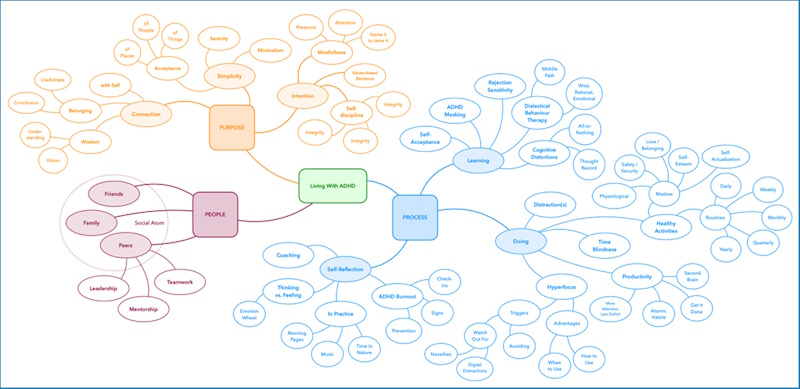
My mind map is structured around three main nodes: purpose, process, and people. The purpose node encapsulates my vision of living life guided by my core values—connection, simplicity, and intention. The process node is dedicated to the practical aspects of living with ADHD, emphasizing continuous learning, action, and self-reflection. Lastly, the people node represents my essential support network, including family, friends, and peers.
The primary benefits of mind mapping for me are multifaceted. It allows me to view my life journey holistically, providing a clear and interconnected overview of my goals and experiences. Mind mapping helps me track my learning journey and explore new interests while keeping my focus on what truly matters to me. It reveals the interconnections between various aspects of my life, highlighting the synergy of addressing them collectively. Moreover, it serves as a valuable record of major topics discussed with mental health professionals, ensuring that I remain aligned with my therapeutic goals and strategies. Through mind mapping, I am able to manage my ADHD more effectively, bringing clarity and intentionality to my life’s path.
Here is my mind map that I developed throughout my sessions:
Potential pitfalls and strategies
What challenges might you encounter when making your mind map? Here are some common problems and ways to navigate them.
All-or-nothing thinking. Consider making a virtual mind map that can be easily edited and adapted over time, alleviating some of the pressure to make it ‘perfect’ the first time you do this exercise.
Overwhelm. Don’t feel pressure to complete your entire mind map in one sitting. Instead, take breaks and approach your mind map as a living document. This will allow you to think of new ideas and add information that you learn over time. Just getting started is already a huge step.
Difficulty initiating. Use a template to help you get started. There is mind mapping software online that offers premade and customizable templates, which may be less intimidating than starting with a blank piece of paper. If you would prefer a physical mind map, you could always print out a template and write directly on that instead.
Staying focused. The beauty of mind mapping is that there is no set way to do it. Jot down whatever comes to mind and stop whenever you feel yourself growing disengaged. You can always come back later and continue adding to it—remember that this is for your benefit, and not a homework assignment that you’ll be graded on later.
Unable to choose a platform. There is no “right way” for a mind map to look or operate. Adapt the format or style of your mind map to whatever works best for you! This means you can use a flowchart, graphic organizer, table, Venn diagram, list, chart—experiment and see what works best for your ADHD brain.
Misplacing your mind map. Keep your mind map somewhere you tend to frequent often—a good strategy may be to keep it in a planner, near a schedule you use to keep track of other tasks, on your phone, or on the fridge. If you tend to misplace physical documents, it may be beneficial to make a virtual mind map and save it on the cloud.
Lack of motivation. Try pairing up with someone and doing this activity together. This could be a friend, family member, or therapist. Having the external accountability might make the whole process a lot easier.
Mind maps are an underused tool to help with executive functioning for those who have ADHD. This approach works with your ADHD brain rather than against it, encouraging you to externalize your inner busy mind, organize your ideas, stay flexible, use your strengths such as creativity, build self-awareness, and get a better overall idea of how you operate. It may also enhance your memory, as well as your ability to make connections, break down complex ideas, and respond rather than react. We encourage you to experiment with mind mapping on your own or with your therapist and/or coach and see if it works for you.
 Adam Ly, MScOT, practices as a registered occupational therapist helping adults with ADHD, cognitive impairments, and mental health difficulties in London, Ontario, Canada. He completed his master of science degree in occupational therapy at Western University. He is an adjunct lecturer at the University of Toronto in the department of occupational science and occupational therapy. He teaches workshops through the Canadian Association of Occupational Therapists in cognitive rehabilitation, as well as neurodiversity-affirming assessment and support strategies for adults with ADHD.