
Between the Sessions: The Power of Showing Up
Community is already waiting.
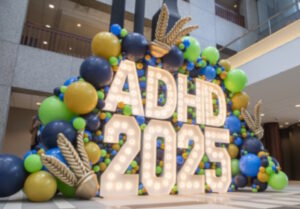 Now that a few months have passed since Kansas City, I’m surprised by what I’m still thinking about.
The sessions I attended were amazing, but it’s the moments between them that keep replaying in my mind. The people I met for the first time who I’ve already had Zoom coffee meetups with once or twice. The hallway conversations that turned into true connections. The new text friendship that began because I took a breath and told someone I loved their podcast—and instead of a quick “thank you,” it turned into “let’s talk.” And we have.
That’s the part of the International Conference on ADHD you won’t find on the agenda—but it matters just as much as the biggest keynote.
When we show up, we do better. Not just for a weekend in November, but all year.
Real learning meets real life
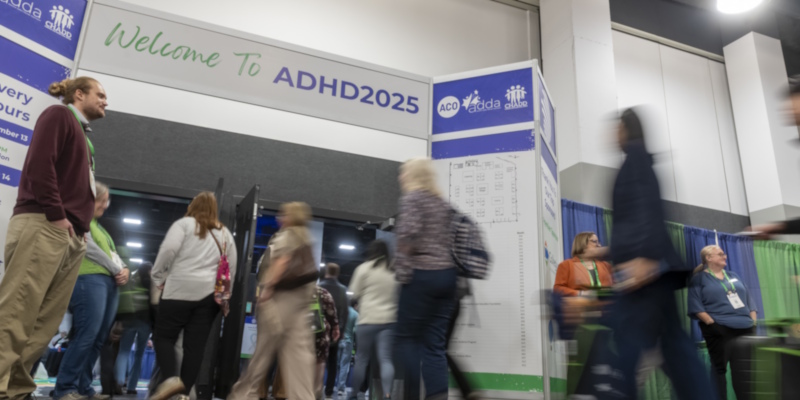
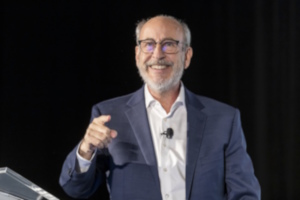
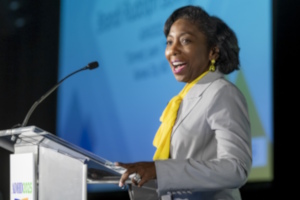
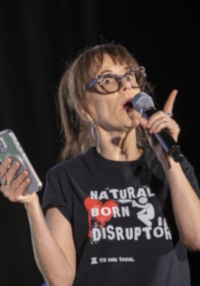
The November 2025 conference—co-hosted by CHADD, the Attention Deficit Disorder Association (ADDA), and the ADHD Coaches Organization (ACO)—was expansive, vibrant, and full of real-life relevance. Sessions unfolded across multiple rooms and tracks, with more choices than any one person could reasonably fit into a single schedule. Adults, parents, educators, clinicians, coaches, advocates—all moving through the same space, each bringing their own questions, experiences, and hopes.
The learning was thoughtful and substantial: research updates, practical strategies, and real-world conversations about relationships, school, work, health, and treatment options. Sessions explored topics that feel especially timely: late diagnosis and identity, women and girls at different life stages (including the role of hormones), the upcoming adult diagnosis and treatment guidelines, and the intersection of ADHD and Autism, among many others.
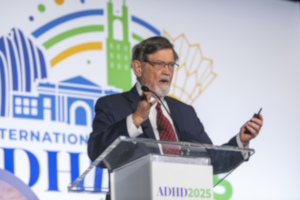
Many sessions reinforced a simple truth: What helps people with ADHD thrive day to day, in the space between doctor’s visits and therapy appointments, often comes from community-based supports like coaching, peer support, and accountability groups. In one session, led by Maggie Sibley, PhD, and Tamara Rosier, PhD, attendees heard findings from the US National Survey on ADHD Coaching, offering new research on coaching as a real-world ADHD support. The co-chairs from the three organizations also purposefully curated time and space for multiple peer support groups each day so learning could turn into scaffolding, the kind that helps people follow through, regulate, and feel less alone after the conference ends.
Care in the in-between
But what made the conference feel special wasn’t just the strength of the content. It was the way learning and humanity traveled together.
There was seriousness—about access to care, policy shifts, and the very real impact ADHD can have across a lifetime. And there was also joy. Relief. Laughter. The kind that comes from being in a room where you don’t have to explain why reminders matter, or why support isn’t a weakness, or why trying again is sometimes the bravest thing you can do.
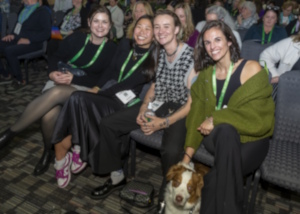
Throughout the week, care showed up in real time. People checked in on one another. Shared snacks and chargers. Helped someone find a quieter space. Compared notes not just on sessions, but on what actually works when life is busy and brains are tired. I saw strangers do the small, practical things that make a big difference when you’re navigating ADHD in the wild: saving seats, walking someone to the next room, swapping notes when someone missed a chunk, and quietly asking, “Do you want company, or do you need a minute?”
And it wasn’t just logistical care. It was emotional care, too. The kind that says, without making a big deal of it: You belong here, even if you’re running late, even if you forgot your meds, even if you’re overstimulated, even if your brain is doing that thing where everything feels like too much. People normalized breaks. They made “no pressure” the default. They reminded each other to drink water, eat something with protein, step outside, or skip a session if their nervous system needed it.
These weren’t grand gestures. They were small, human ones, and they added up.
When connection turns into community
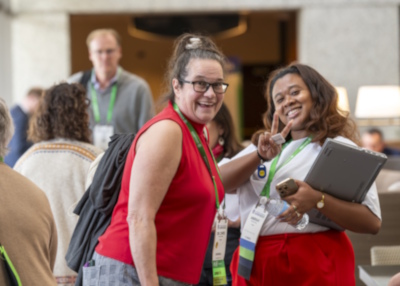
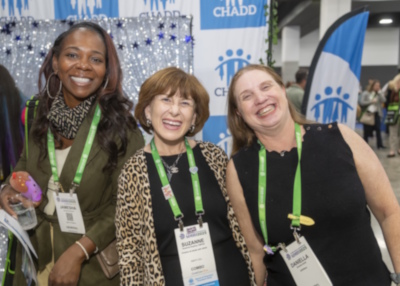
I saw a version of that “between the sessions” magic at the welcome reception, near the CHADD booth. In the middle of the noise and joyful chaos, I spotted two volunteers I consider friends and I was genuinely surprised to realize they clearly knew each other well.
So I asked, “Wait… how do you two know each other?”
They laughed and said, “Through CHADD… and also, kind of through you.” They reminded me that months earlier, I’d encouraged both of them to join the same committee and helped make the process feel doable. That shared “yes” turned into a real friendship—one they’ve continued to nurture across state lines and life changes.
The very ADHD twist? I didn’t remember I’d played any part in it.
But that moment stayed with me. It reflected what happens when people are offered a clear, welcoming path into participation, contribution, and belonging. With CHADD, volunteering isn’t a closed circle. It’s an open door. Community doesn’t form by accident. It grows because people build the container, extend the invitation, and make that first step feel possible.
Community doesn’t just support people.
It multiplies impact.
If you want a bigger-picture example of how conference connections can ripple outward, look at Elaine Taylor-Klaus and Diane Dempster, co-founders of ImpactParents. They’ve shared that their partnership traces back to connections made through the CHADD conference world. It’s a reminder that a single conversation can grow into a collaboration, and a collaboration can become support that reaches far beyond the conference itself. This year in Kansas City, CHADD honored both Elaine and Diane with the Hall of Fame Award, and it felt like a full-circle moment.
Community doesn’t just support people. It multiplies impact. That theme surfaced again and again throughout the conference.
It showed up in sessions where science and lived experience sat side by side. In conversations where people held both the challenges of ADHD and the strengths that often come with it. In moments where someone realized they weren’t failing—they were navigating something genuinely hard, and they didn’t have to do it alone.
We also celebrated the future of the field through recognitions like the Dr. Thomas E. Brown Pioneer Award, formerly CHADD’s Young Scientist Research Award, honoring emerging research leaders and reminding all of us that progress is personal and collective.
This year, that recognition also held a deeper layer: it honored the late Dr. Thomas E. Brown’s legacy. We were joined by his son, daughter-in-law, and grandchild to celebrate the newly renamed award’s first two recipients. It was a powerful reminder that the work moves forward because people build on what came before.
One of the things this conference does exceptionally well is hold multiple truths at once. That ADHD can be deeply impairing. That people with ADHD are resilient, creative, and capable. That support needs to be evidence-aligned and compassionate. That outcomes improve when education, care, and community work together.
And perhaps most importantly, it reminds us that progress doesn’t happen through information alone. It happens through relationship.
The invitation: keep showing up
When people show up—to learn, to listen, to volunteer, to share what’s helped them—something shifts. Insight becomes more accessible. Shame softens. Strategies feel more doable. People leave not just with notes in a notebook, but with a sense of traction.
That’s why the conference stays with you.
Not because it solves everything, but because it shows what’s possible when people are supported by a community that understands them.
In many ways, the conference is a heightened version of what CHADD exists to offer all year long. It’s the loudest expression of something that happens more quietly—and just as meaningfully—in meetings, support groups, education events, and volunteer spaces across the organization. Places where people return not because they have to, but because showing up makes life feel a little more manageable and a lot less lonely.
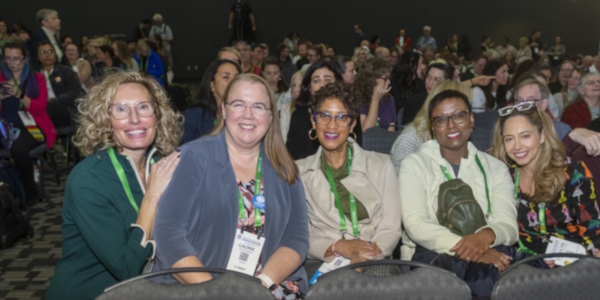
When we show up, we do better—for ourselves and for each other. Our challenges don’t disappear, but they stop being isolating. Our experiences are met with understanding. And over time, that shared understanding becomes collective strength.
Whether this conference is your first connection to CHADD or one part of a longer journey, I hope you’ll keep leaning in—to the community, the conversations, our education events, and the many peer support meetings where you can both support others and be supported.
There’s a place for you at CHADD. Not just for a week in November, but all year long.
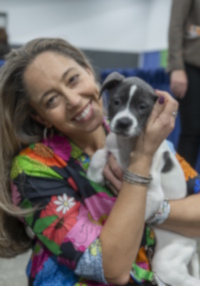
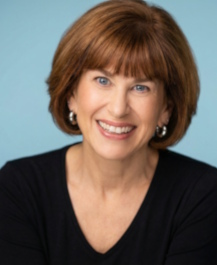 Suzanne Sophos, CMPSS, is president of the board of directors of CHADD and director of CHADD of California. In her role with the California chapter, she oversees one of the nation’s largest ADHD communities, with an active online space and more than thirty monthly support, education, and social meetups. She serves on the leadership steering team for the International Conference on ADHD and has been a member of the conference committee since 2020. A certified peer support specialist and coach, she is the founder of Brave Spaces, where she offers group and private peer support and coaching. She is also a nationally regarded speaker on ADHD and AuDHD, with a focus on belonging and identity, community-based support, and the real-world factors that shape outcomes.