

I’ll Be Happy When…: ADHD and the “Rat Race”
Attention Magazine February 2026
When I catch up on emails, I’ll relax. When my house is finally organized, I’ll have friends over. When I get my ADHD under control, I’ll start living.
Sound familiar? If you’re nodding along, you’re not alone.
 Millions of ADHD adults are trapped in what I call the “deferred permission” loop: constantly putting off joy, rest, and satisfaction until some mythical future when we’ve finally got our act together.
The problem is that the future never quite arrives. Just when we think we’re catching up, another deadline looms. The moment we get one area sorted, chaos erupts somewhere else. We’re constantly chasing a moving target, and the goalposts keep shifting further away.
We tend to blame this on a character flaw or our lack of willpower. In fact, it’s the predictable result of an ADHD brain trying to function in a world that wasn’t designed for how we think, while absorbing wider cultural messages that connect our worth as people with our output or productivity.
The ADHD brain and future-self fantasy
To understand why we get stuck in this pattern, we need to look at what’s happening inside our heads. ADHD is fundamentally an executive function impairment: a mismatch between our brain’s prediction machinery and real-life, real-time demands. Our working memory, the mental workspace where we hold and manipulate information, operates more like a leaky bucket than a reliable container.
When we try to envision our future organized self, we’re asking an already-taxed cognitive system to do something incredibly demanding: hold multiple variables in mind, sequence them over time, and maintain motivation for a distant reward. It’s like asking someone with dark sunglasses to thread a needle in a dark room: technically possible, but exhausting and often unsuccessful.
Jeff Copper’s Cognitive Ergonomics From the Inside Out™ (CEFIO) framework helps us to understand this through a crucial insight: When cognitive effort becomes literally “painful” or too much, our brain’s automatic response is to escape. That’s why planning for future happiness feels simultaneously urgent AND impossible. We know we should organize our lives, but the thinking required to get there triggers what Copper calls the “escape reflex” and suddenly we’re scrolling through social media, eating straight from the fridge, or reorganizing our sock drawer instead.
Meanwhile, our dopamine-driven reward system, already running low, craves reward now, not in six months. The abstract promise of future contentment just can’t compete with the concrete relief of our ‘avoidance’ behaviors.
The cultural trap: rest as reward
Our struggle isn’t just neurobiological. In both the United States and the United Kingdom, it’s also cultural. We’ve absorbed the message that rest must be “earned,” that joy is a luxury reserved for after productivity. This “rest as reward” mindset is especially devastating for ADHD brains, which often need more downtime to function at our best.
Consider the absurdity: We’re told to work harder to earn the right to rest, but we also need rest to work effectively in the first place. It’s like being told you can only drink water after you’ve run a marathon while you’re already dehydrated.
The truth is, rest CANNOT be a reward for “good behavior.” It is essential maintenance of what researchers call our body-budget, the energy reserves that power executive function. When we chronically defer rest, we’re essentially running our cognitive engine on empty, then wondering why we can’t reach our destination and there’s steam coming out from the hood (“bonnet” in the UK).
From victim to creator: the empowerment dynamic
The “I’ll be happy when…” mindset keeps us trapped in what the Drama Triangle calls our “victim” orientation—when life is happening to us, and we can’t get away from it, we look for a rescuer (our escape). When we’re focused on the problems (what’s wrong, what’s missing, what needs fixing), our attention narrows to that painful circumstance and our energy disappears.
We become reactive, constantly focusing on the latest crisis because that feeling—the boredom, the shame, et cetera—are shouting at us louder than the thing we really want that’s further away.
The “creator” orientation offers a different approach. Instead of asking, “What’s wrong with me that I can’t get organized?” we ask “How would ‘organized’ look in my life? What is it going to feel like when I know where my keys are 100% of the time?” Instead of “Why am I always behind?” we wonder, “What would support me in taking a step to get started?” But that’s hard to practice when we’re not giving ourselves the time or rest to realize we don’t have to keep punishing ourselves.
We don’t need to pretend that everything is great—positive thinking rarely works when we know what’s not right. Instead, we need a fundamental shift in where we direct our mental energy and resources. Problem-focused attention keeps us stuck in the very patterns we’re trying to escape. Outcome-focused attention opens up possibilities and energizes us to take action.
The myth of “catching up”
Let’s address the elephant in the room: the idea that we can ever truly “catch up.” This myth is particularly seductive for ADHD brains because it promises an end to the constant sense of being behind. But what if catching up wasn’t actually the goal anymore?
What if, instead of trying to eliminate all sources of “pushing on” and “why can’t I keep up,” we designed our lives around accommodation rather than self-punishment?
I won’t deny that this requires a radical reframe.
Instead of seeing our need for external structure as a personal failing, we recognize it as simply honoring how our brains work.
Instead of shame about needing more rest, we fully accept our cognitive differences.
Instead of grinding toward some perfect future self, we ask: what would make today a little easier?
Small steps, big shifts: the 4N Loop
The path out of deferred joy and permission isn’t through massive overhauls—it starts with what I call the 4N Loop: Notice (what’s happening now), Name (the feeling or action we’re doing), Needs (what we want the outcome to be instead), and Next Baby Step. This is deceptively simple but creates quick, powerful changes in what we’re doing and how we’re responding.
Permission slips for the present
Here are some ADHD-friendly ways to reclaim permission for joy and rest right now.
● Permission to rest without earning it. Your brain needs downtime to consolidate information and restore executive function. Rest is neurologically necessary and our brains work so much better afterwards.
● Permission to enjoy imperfection. That pile of unfolded laundry? It can coexist with having friends over. Your worth isn’t measured by your organizational systems. One of my clients has a “welcome to the chaos” sign at her door—and visitors smile, feeling honored she trusts them enough to want their company no matter what.
● Permission to change your mind. Made plans when you were feeling energetic but now you’re depleted? It’s okay to adjust. Reset the GPS and aim for the fuel station. Flexible frameworks serve ADHD brains better than rigid rules.
● Permission to ask for help. Your brain works better with external support. Needing and accepting accommodation is wisdom.
● Permission to prioritize what matters to you. Not everything urgent is important. Not everything that seems important to others has to be important to you.
Practical strategies for present-moment joy
The two-minute rule, reversed. If starting a task is a problem, instead of “if it takes less than two minutes, do it now,” try “if it brings me joy and takes less than two minutes, do it now.” Put on a song you love. Text someone you appreciate. Step outside and notice something beautiful. Your happier brain is now in a better place and the next job will feel easier.
● Micro-celebrations. Notice when you do something well, however small. Sent that difficult email? Celebrate. Made it through a challenging meeting? Acknowledge it. These micro-moments of recognition build new neural pathways, especially in brains that have a different response to rewards. Give yourself a high-five even if nobody else is around.
● The energy check-in. Throughout the day, ask yourself: “What’s my energy level right now, and what does this energy need?” Sometimes it needs movement, sometimes stillness, sometimes connection, sometimes solitude. When in doubt, experiment—you’d be amazed how movement or laughter can create energy.
● Permission slips. Literally write yourself permission slips. “I give myself permission to spend Saturday morning reading in bed.” Post them where you’ll see them.
The paradox of present-moment focus
The beautiful paradox is this: When we stop desperately chasing future happiness and start tending to present-moment wellbeing, we often find ourselves naturally moving toward the outcomes we wanted anyway. Not because we’re grinding toward them, but because we’re operating from a foundation of rest and joy rather than depletion and striving.
A well-rested, supported ADHD brain is more creative, more flexible, more capable of the actions we thought we needed to achieve before we could rest. The energy we were spending on future-focused anxiety becomes available for present-moment activity and thinking.
This isn’t the same as abandoning all goals or plans. It just means we are recognizing that sustainable progress comes from a place of solid foundation, not desperation. We’re building on firm, solid ground that isn’t full of holes (tiredness) or rocks (frustration). It means trusting that taking care of ourselves is a strategy with the best outcome.
Designing your life for who you are now
The final shift is perhaps the most radical: designing your life for who you are now, not who you think you should become or “have the potential” for. Let’s ban “potential”—it’s a trap.
Instead, start designing systems at home and work that support your ADHD brain now rather than what you “should” do. It means giving yourself the accommodations you need without waiting for permission from others.
What if your future self isn’t someone who has “overcome” ADHD, but someone who has accepted and learned to work with it skillfully—maybe delightfully?
What if happiness isn’t a destination you reach after fixing everything, but a way of being available to you right now (for free)?
Have you got a big grin yet?
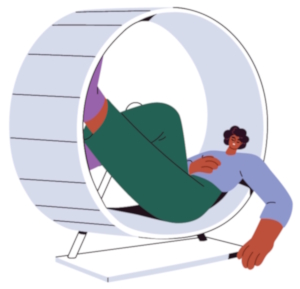
The rat race will always be there, offering its promises of future satisfaction. It’s how they keep us hooked on social media, shopping channels, snacks, magazines—all those things that our ADHD brains hoover up to escape the frustration. That’s okay—it’s their job—but we don’t need to buy into all of it.
You don’t have to keep running that race.
You can step off the track, take a breath, and ask yourself: what do I need right now?
And then, with compassion and curiosity, you can give yourself permission to take the next baby step toward it.
After all, the only moment you can actually be happy is this one.
 Katherine Sanders, PhD, PCC, is an ADHD coach, podcaster, and the founder of Lightbulb ADHD, a Scotland-based coaching practice for adults who are ready to move beyond shame, perfectionism, and “try harder” advice. Drawing on advanced training with the ADHD Coach Academy (ADDCA), the Empowerment Dynamic (TED) and DIG Coaching, her own late diagnosis and parenting a neurodivergent teen, she helps clients translate fuzzy, overwhelming inaction into clear insight, practical experiments, and self-trust. A former egg tempera artist, reproduction costume maker, picture-maker, and academic with a PhD from the University of Edinburgh, she recently published a white paper and comprehensive industry report on the current state of ADHD coach training and the ethical issues facing anyone who works with or wants to know more about ADHD coaching. She is currently preparing her new methodology and an unusual group program for 2026, while creating engaging workshops for organizations who want to support neurodivergent staff more thoughtfully. You can learn more about her work at