September 2026
Raising awareness about suicide prevention is important for the ADHD community. People with ADHD can struggle with strong emotions, impulsive actions, and other mental health concerns. Research suggests they may be three to four times more likely to have suicidal thoughts and two to three times more likely to attempt suicide. The risk can be even greater when they have coexisting conditions such as depression, anxiety, bipolar disorder, substance use disorders, or other mental health conditions.
Recognizing warning signs early and having access to support and treatment can help reduce the risk of suicide. Families, healthcare providers, schools, and communities can all play a role by listening, taking concerns seriously, and helping to get care when it is needed.
If you or someone you know is in crisis: Call or text 988 (Suicide & Crisis Lifeline) or text TALK to 741741.
CONFERENCE PRESENTATIONS
Assessing and Treating Suicidality and Self-Injury in ADHD Clients
Assessing and Treating Suicidality and Self-Injury in ADHD Clients
In this conference presentation, Emily Kircher-Morris, MA, MEd, LPC, explains why people with ADHD may be at greater risk for suicidal thoughts and self-injury, including challenges with managing emotions, acting impulsively, handling frustration, and having other mental health conditions. She also looks at how sensory needs and difficulties in different environments can affect assessment and treatment.
Recordings of selected educational sessions from past annual international conferences on ADHD can be purchased from CHADD’s online store.
ADVOCACY
CHADD supports the 988 Implementation Act in the 119th Congress, to be reintroduced this month by Representatives Matsui (CA-07) and Fitzpatrick (PA-01).
This comprehensive bill would:
- Solidify funding for 988 regional and local call centers to ensure a timely 24/7 response to callers anywhere in the country.
- Provide funding for community-based crisis response, including mobile crisis teams and crisis centers.
- Support crisis workforce development with increased funding for training and scholarship opportunities.
- Increase access to care by requiring that all health insurance plans cover crisis services.
- Implement a national suicide prevention awareness campaign in partnership with a wide array of stakeholders.
PARTNERSHIPS
Young people with ADHD face a significantly higher risk of suicidal behaviors and suicide attempts than their peers without ADHD. CHADD is honored to collaborate with Jake Collective, a nonprofit foundation dedicated to improving the lives of neurodivergent young people and advancing meaningful solutions to this critical issue.
Jake Collective is building strategic partnerships to help move society towards a future in which young neurodivergent people feel truly seen and understood—and families, clinicians, educators, and communities have the knowledge and tools they need to support them and save lives. The organization was founded in honor of Jake Schreiber, who was diagnosed with ADHD as a child and died by suicide at age 19. His story—and the urgent need for greater understanding, prevention, and support—are at the heart of Jake Collective’s work.
PODCASTS
ARTICLES
Selected News Articles
- ADHD Linked to Increased Risk for Suicide Attempts in Adolescents (Psychiatry Advisor, May 12, 2026)
- Antipsychotics and Mood Stabilizers Linked to Lower Suicide Mortality in Adults (Psychiatry Advisor, March 23, 2026)
- ADHD Pharmacotherapy Associated With Reduced Suicidal Behavior Risk (Psychiatry Advisor, March 18, 2026)
- Suicide Rates Increased for Most Race, Ethnic Groups From 2018 to 2021 (Psychiatry Advisor, February 14, 2023)
- What to Know About the Link Between ADHD and Suicide (Healthline, June 29, 2022)
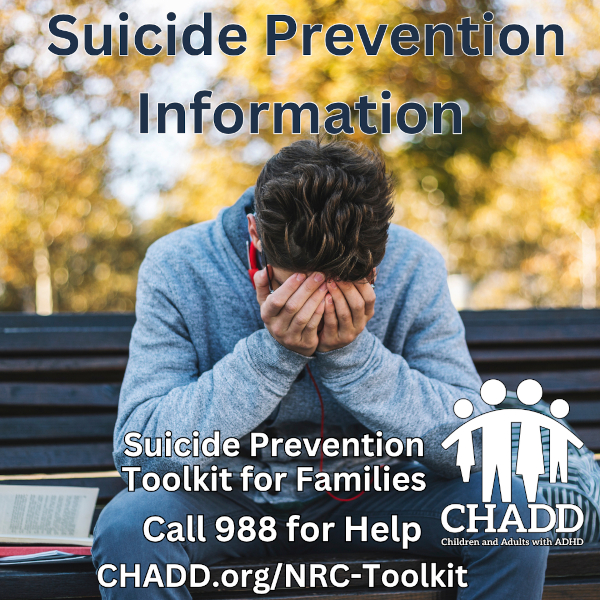
Find additional resources on ADHD and suicide prevention in the Library Catalog of CHADD’s National Resource Center on ADHD.
If you need to speak with someone, contact an ADHD Specialist (Hablamos Español) at 1-866-200-8098, M–F, 1–5 pm ET.
If you or someone you know is in crisis: Call or text 988 (Suicide & Crisis Lifeline) or text TALK to 741741.