
Retooling Strategies for Greater Success, Part Three: Finding Flow
Margaret Foster, MAEd
Download PDF
Going deeper with executive function tasks that are resistant to intervention
Students come to parents, teachers, academic coaches, and therapists with a range of executive functioning (EF) skills they use to manage their academic day successfully. Whether they experience challenges managing a planner, addressing long-term assignments, social skills, or just getting through the day, we are there to help them with a variety of skills and strategies to help them grow and flourish. When those highly useful strategies fail to provide effective results, it’s time to dig deeper, engage more fully in terms of their “problem of practice,” and together discover the very specific tripping points in their day.

Current research about EF training compels us to “rethink… individual differences, relevance, and engagement from a contextual framework” (Niebaum and Munakata). These researchers ask in one of their most recent titles: Why doesn’t EF training improve academic achievement? One of my favorite exercises is to take such “scary” questions posed by new research, understand their component parts and theories, and create or remodel my strategies to realign with them. I have done just that in this series and have added a few more supporting studies to support each protocol.
Niebaum and Munakata’s research shows that training discrete EFs in isolation (in games and exercises that are not embedded in the context of their school subjects or routines) do not generalize to school success. Their report demonstrates that broader success is achieved when EF training is embedded in relevance, deeper engagement, and in a context that is unique to the student.
Specifically, they emphasized that EFs are inherently goal-driven cognitive processes. Goals, and an individual’s motivation to achieve them, are driven by personal, historical, social, and cultural contexts. Even if interventions aimed at improving specific EFs [in isolation] were successful, children’s decisions to engage EFs could remain unchanged, preventing transfer to outcomes in the classroom or the real world. In addition, Ashby and Crossley (2012) describe this as building both episodic memory and procedural memory, which builds strength and automaticity over time.
Most students want to succeed in school, to please their teachers as well as their parents; consequently, many of our usual interventions can and do succeed with simple instruction. But what if they don’t? What if the problems are more complex or too persistent? How do we reach in and help that student re-engage and find success?
There are many ways practitioners address this, but this brief series addresses three fluid strategies, or protocols, that tap into these persistent fluid problems of executive functioning and engage students. Part one examined Think Alouds, a simple protocol that encourages us to step back and share an exploration of the persistent problem with the student. Part two, the 4-Quadrant Sort, clarifies and prioritizes which EF challenge needs to be addressed next. Part three, Finding Flow, focuses on creating a flow chart to represent the steps, sequences, and decisions of a process like a long-term assignment.
Each of these protocols paired with redesigned graphic organizers have a few things in common: They will immerse us even more deeply in the student’s perception and context of their unique school life, they can untangle the most persistent problems, and most importantly, they are shared.
Finding Flow
This final protocol is so simple it’s almost embarrassing, but its success relies heavily on those observations of Niebaum and Munakata which led to the idea that we must be “training executive function engagement, rather than training executive functions directly.”
In order to be engaged in executive functioning, we must first engage—or initiate. Initiation as an EF term is defined as “a child’s ability to begin a task or activity and to independently generate ideas, responses, or problem-solving strategies” (according to Isquith, Gioia, et al, designers of the EF Inventory commonly referred to as the BRIEF). And that means helping our students create procedural maps of the ideas, decisions, and sequences of a complex problem in order to engage with them efficiently—even if they have serious problems with EF tasks.
A quick example: one of the banes of the EF world is the dreaded long-term assignment. That’s because it’s often five assignments (or more) wrapped into one seemingly innocuous title: science fair or research paper or oral presentation—even show and tell. It sounds like one assignment, but it’s really “a riddle wrapped in a mystery inside an enigma” (Churchill).
Let’s break it down. Step 1: Think of a topic; Step 2: Do the research; Step 3: Get permissions/references (I once had a student bring their mother’s dentures for show and tell––they should have obtained permission); Step 4: Get it ready (first draft); Step 5: Edit (permissions would work here as well); Step 6: Final draft or presentation.
Each of these steps has EF demands of its own. “Think of a topic” requires myriad ideas and decisions around what is important, interesting, acceptable—and easy. And so on with each of the steps. The problem with “steps” is that they’re usually static and are represented visually as static events:
- Step 1 Think of Topic
- Step 2 Do the Research
- Step 3 Get Permissions
- Step 4 First Draft
- Step 5 Edit
- Step 6 Final Draft
See the boxes? See the separate lines? Start and stop. Start and stop. It’s a nice summary of the work breakdown, but it does not visually represent the flow or ongoing nature of the project, and it is not student context based. In addition, it’s not student-created so, while the teacher’s/parent’s EF skills are improved by the development of this list, the student’s are not. This might still work for many students, but again for students who really struggle with EF skills, or with problems with initiation in particular, or those with persistent problems with long-term assignments, more is needed.
Here is another model:
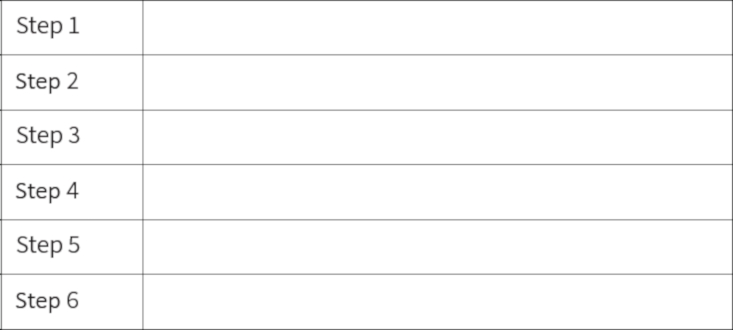
Again, with the boxes. Again, the start and stop. While this chart does encourage the student to enter their own words, we can do better.
Example of a flow chart
Although it seems like only a slight variation, the following flow chart has “broken open” the EF challenges for my students, helping them get past that first horrible “ugh” and providing them with a map that represents a procedural script they have personally verbalized and visualized. We used Zoom’s Whiteboard, and my student was asked to develop this with their own low fine-motor hands, so it took a little time—but only the first time around. They soon figured out strategies for copy/paste and decided not to be perfectionistic (which was a real temptation for this student.) I was not worried about spelling or punctuation as that would have diverted them from processing the complexities of their EF tasks.
This was our first flow chart online with Zoom. I took dictation on the first line while the student produced the second line (note the difference in spelling and punctuation; I like the second one better because it was student-generated). These can be done with Zoom offline as well.
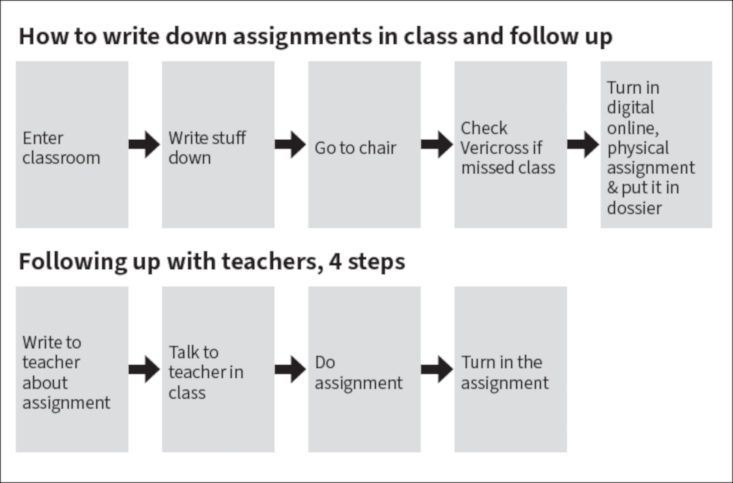
And then…
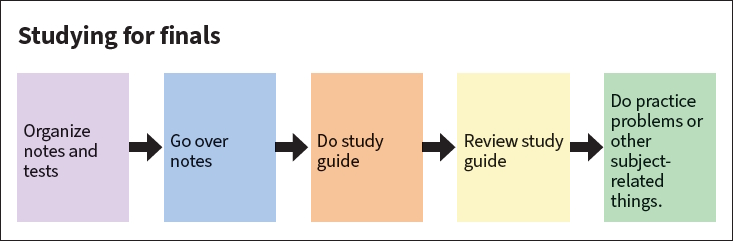
Note the addition of color and form (but not spelling or punctuation).
What really surprised me here is that this student automatically took out their planner and assigned these mini-assignments to different days of the week––something we had worked on, but always with prompting or priming (See part two, the 4-Quadrant Sort, for more on that). This was a big deal in my world!
We charted other things, too, just to get used to thinking in process; for example, How to make a comeback after being out sick:
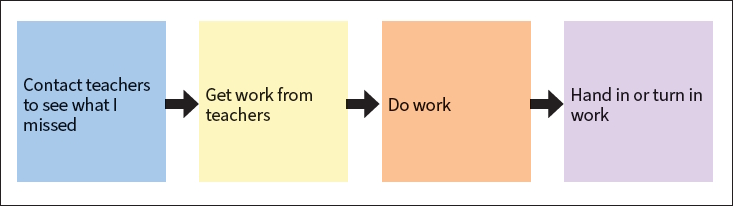
And finally, to build fluency and independence, I prompted “What is the process we go through every time we meet?”
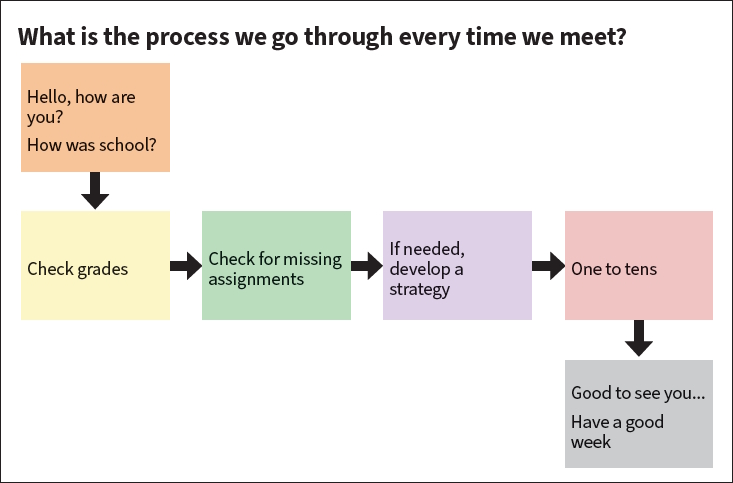
I added the orange and gray boxes just to remind the student that it wasn’t all work and no conversation, but the representation belongs to the student and that’s what was drawn.
In our pursuit of efficiency, we often provide these models for our students rather than give them time to imagine the process on their own and design their own flow chart. Again, while a teacher- or parent-designed model may work for some, for students who have persistent problems with initiating and staying engaged, this approach has turned their groans into “ahas.” I have to admit that two of my biggest goals for my students who need academic coaching are (1) building effective strategies, and (2) becoming more efficient. But, while efficiency is good, effectiveness always comes first.
Using re-tooled strategies and mindsets
Student engagement, specificity, and capturing these processes in dynamic redesigned graphic organizers: These are the important features defined by research, discussed in this series, and recently re-informing my weekly practices with students.
Executive function training can improve academic achievement if we train EF engagement in specific tasks, rather than training disengaged EFs. We need to keep these key features in mind and re-tool the strategies and mindsets we use with students.
This series has addressed three examples of re-tooled strategies: Think Alouds, the 4-Quadrant Sort, and Finding Flow. Which problems of practice will you address? Which strategies will you modify?
 Margaret Foster, MAEd, is a learning specialist and leading consultant in the areas of executive functioning, special needs, and program development. An educational coach, former classroom teacher, and speaker at national and international conferences such as The Council for Exceptional Children, CHADD, Project Zero, and Learning and the Brain, she has trained parents, educators, and school leaders around the globe. In addition, Foster has produced numerous articles, including a special column for MedCentral and has coauthored a book, Boosting Executive Skills in the Classroom: A Practical Guide for Educators. She is a member of CHADD’s professional advisory board.
ADDITIONAL READING
Ashby F, Crossley M. (2012). Automaticity and multiple memory systems. Wiley Interdisciplinary Reviews: Cognitive Science, 3. 10.1002/wcs.1172.
Isquith PK, Gioia GK et al. BRIEF2 Behavior Rating Inventory of Executive Functions 2nd Edition: Interpretive Report for Clinicians. PAR 2022.
Niebaum JC, Munakata Y. (2023). Why doesn’t executive function training improve academic achievement? Rethinking individual differences, relevance, and engagement from a contextual framework. Journal of Cognition and Development, 24(2):241-259. https://www.tandfonline.com/doi/full/10.1080/15248372.2022.2160723
Other Articles in this Edition
Five Steps to Building Stronger Friendships
ADHD and Digital Media Use in Teens and Young Adults
Front-End Strategies to Avoid Power Struggles and Meltdowns
Retooling Strategies for Greater Success, Part Three: Finding Flow
Why Camp Can Be So Hard for Kids with ADHD
ADHD Camp or No Camp: Plan Your Child’s Summer
Post-Pandemic Boom in ADHD Coaching Revealed in New Study